Existentialism For Beginners by David Cogswell
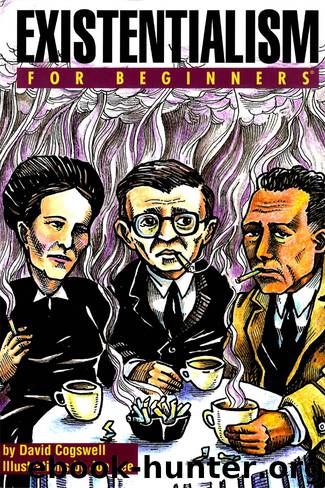
Author:David Cogswell
Language: eng
Format: epub
Publisher: For Beginners
Published: 2013-03-02T05:00:00+00:00
An Alternative Method of Knowing
Husserl created a bridge between the thinking and spirit of Nietzsche and Kierkegaard and the earlier Cartesian tradition of logic, and laid the groundwork on which Heidegger and Sartre attempted to build twentieth century existentialism as a systematic philosophy.
Husserl was an exponent of classical rationalism, but he wanted to ground the rationality of mankind on a more solid and comprehensive basis than previous philosophers.
He offered an alternative view to that of positivism and the scientific, objective view. Positivism states that the only valid knowledge is from scientific inquiry, the positive affirmation of theories formulated using the scientific method. But Husserl said that all of our knowledge of so-called objective phenomena is based on subjective experience. Therefore, our subjective experience is really the more fundamental source and ultimately the most reliable.
Husserl said philosophers should cast aside all systems and preconceptions that filter their perceptions and look directly at the phenomena themselves, the actual concrete data of experience. “To the things themselves,” was the slogan of phenomenology, meaning a return to the sources themselves, casting off all preconceptions and readymade forms and theories. Philosophy must return to a pure description of what is, Husserl said.
Husserl gave validity to our experience of the world, as distinct from those who asked whether the world was real, or said it is only an outgrowth or creation of the mind, or those who said that the only reliable source of knowledge of the world was through scientific instruments and that the senses and the direct experience cannot be trusted.
Husserl brought a kind of direct realism to philosophizing. That which you see and experience is the real world, he said. His goal was to try to find a point of departure that was pre-systematic, pre-theoretical, something that would underlie different or opposing philosophizing, a common ground of pre-conceptual experience and perception.
Download
This site does not store any files on its server. We only index and link to content provided by other sites. Please contact the content providers to delete copyright contents if any and email us, we'll remove relevant links or contents immediately.
| Anthropology | Archaeology |
| Philosophy | Politics & Government |
| Social Sciences | Sociology |
| Women's Studies |
The remains of the day by Kazuo Ishiguro(8999)
Tools of Titans by Timothy Ferriss(8396)
Giovanni's Room by James Baldwin(7346)
The Black Swan by Nassim Nicholas Taleb(7129)
Inner Engineering: A Yogi's Guide to Joy by Sadhguru(6796)
The Way of Zen by Alan W. Watts(6614)
The Power of Now: A Guide to Spiritual Enlightenment by Eckhart Tolle(5782)
Asking the Right Questions: A Guide to Critical Thinking by M. Neil Browne & Stuart M. Keeley(5775)
The Six Wives Of Henry VIII (WOMEN IN HISTORY) by Fraser Antonia(5515)
Astrophysics for People in a Hurry by Neil DeGrasse Tyson(5190)
Housekeeping by Marilynne Robinson(4447)
12 Rules for Life by Jordan B. Peterson(4304)
Ikigai by Héctor García & Francesc Miralles(4274)
Double Down (Diary of a Wimpy Kid Book 11) by Jeff Kinney(4272)
The Ethical Slut by Janet W. Hardy(4253)
Skin in the Game by Nassim Nicholas Taleb(4249)
The Art of Happiness by The Dalai Lama(4130)
Skin in the Game: Hidden Asymmetries in Daily Life by Nassim Nicholas Taleb(4007)
Walking by Henry David Thoreau(3962)
